Trust collapse
Only 39% of consumers trust advertising in general, forcing a dependence on peer-to-peer validation aka community.
Data scarcity
The deprecation of third-party cookies makes owned, first-party data, sourced from your community, mandatory for personalisation and attribution.
CLG is profit
Community-led growth is fundamentally a retention strategy, where a mere 5% increase in retention can boost profits by up to 95%, according to Bain.
Mobilise your fans
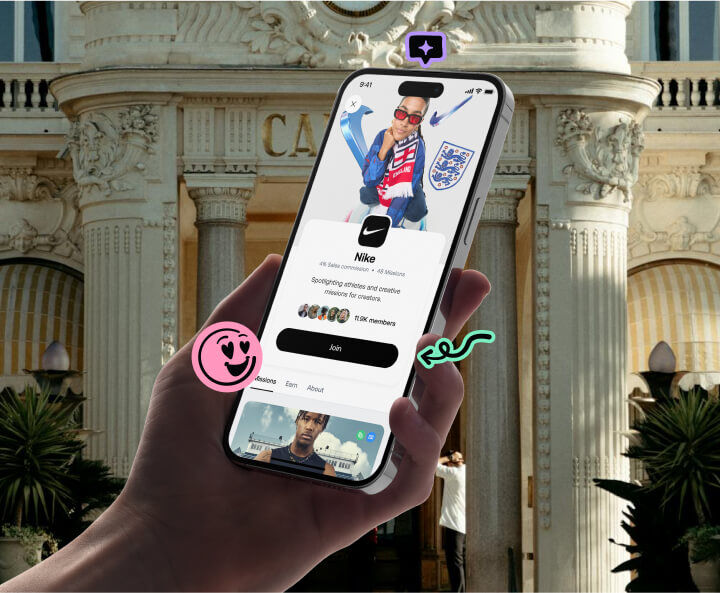
Platforms like Club are used by brands to automate community engagement, turning loyal customers into sales-driving brand advocates who generate highly trusted content.
The cost of inaction
Brands that delay this pivot risk high churn rates and financial failure in a fiercely competitive, trust-based market.
The looming crisis: Why traditional B2C marketing dies in 2026
The consensus across the marketing landscape is clear: the foundational strategies that drove B2C growth over the last decade are rapidly becoming liabilities.
For brands relying heavily on paid media and third-party data, 2026 represents an existential deadline. The efficiency of traditional advertising models is collapsing under the weight of consumer skepticism, regulatory shifts, and structural increases in acquisition costs.
Businesses that fail to acknowledge this tectonic shift and pivot to a consumer-centric, community-first model risk immediate marginalisation and eventual failure.
1. The trust deficit: Analysing the collapse of ad credibility
Consumer trust has transitioned from being a subjective soft metric to the primary conversion barrier. Data from The Advertising Association indicates a critical failure in traditional advertising effectiveness: only 39% of consumers trust advertising in general.
This low level of confidence stands in sharp contrast to the consumer requirement for purchase, where 88% of all buying decisions are influenced by trust.
The underlying implication of this data is profound: $5 billion in ad spend was wasted in 2022 because it failed to further commercial objectives.
Continuing to scale paid campaigns without solving this trust deficit guarantees a perpetually high floor on customer acquisition costs (CAC). Furthermore, consumers actively signal their distaste for disruptive paid formats, with 73% disliking pop-up ads.
When consumers do seek credible information, they bypass brand broadcasts entirely. They rank creators, individuals who have cultivated authentic communities, as the number one trusted source over both social media ads and celebrities.
The causal link is undeniable: high-paid spend generates low perceived trust, leading to an inability to influence purchases, ultimately ensuring diminishing ROI. The only scalable, authentic source of trust capable of mitigating this risk is peer-to-peer validation, inherently found in a brand community.
2. The great data reckoning: Third-party cookie deprecation and the $0 value proposition
The structural collapse of traditional digital advertising is accelerated by the phasing out of third-party cookies. This is more than a technical adjustment; it represents the demise of the core attribution and personalisation engine that modern B2C marketers rely upon.
Measures like Firefox’s Enhanced Tracking Prevention (ETP) already restrict cross-site tracking, making retargeting based on users’ browsing history extremely difficult and potentially impacting the accuracy of analytics data.
The commercial consequences are severe. Early reports on Google’s Privacy Sandbox indicate that publishers could lose an average of 60% of their revenue. As the ability to precisely track and retarget audiences evaporates post-2026, the cost of reaching the right consumer through opaque ad channels will skyrocket.
Despite this data fragmentation, the consumer expectation for relevance remains high, with 71% expecting companies to deliver personalised experiences.
When third-party data vanishes, satisfying this expectation through inefficient paid means becomes prohibitively expensive, leading to bloated CAC and organisational frustration. The strategic solution is to pivot sharply toward first-party data capture.
An owned brand community, by definition, becomes a reliable, proprietary source of first-party data, transforming engaged customers into data generators and securing a brand’s ability to personalise marketing ethically.
3. The ROI illusion: Escalating CAC vs. diminishing returns
The financial trap facing the B2C sector is the simultaneous growth of marketing budgets and the decline of paid channel efficacy. While overall marketing budgets are growing cautiously (3.3% in 2025), driven primarily by increased digital spending (up 7.3%), the efficiency of that spend is actively eroding.
While conventional theory suggests 4:1 return on ad spend (ROAS) is “good,” current data shows that most industries come in well below this threshold.
Brands are caught in a feedback loop: they spend more on channels that return less, directly squeezing their margins. This financial pressure is starkly visible in sector data: the wellness sector averages a 1.45% ROAS (return on ad spend) on Facebook, and beauty sits at 1.57%. Both fall well below the industry median of 2.19%.
This unsustainable paid model stands in stark contrast to the colossal returns generated by organic channels: SEO boasts an average ROAS of 9.4%, meaning brands generate $9.4 in revenue for every $1 spent on SEO with an average ROI of 825%.
The average ROI for email marketing ranges from $36 to $40 for every dollar spent. The data demonstrates that continuing to chase traffic through high-cost, low-trust paid channels is financially irresponsible; the future of profitability belongs to strategies that inherently fuel high-ROI organic growth vectors, placing community at the epicentre.
The new centre of gravity: putting the consumer (and community) at the heart
Survival in the 2026 landscape demands a foundational pivot from a transactional, product-out marketing approach to a relational, customer-in model. This pivot defines the brand as a convener of shared interests, not just a seller of goods.
1. The expectation economy: Authenticity and participation
Today’s consumer expects radical transparency and authenticity. They view brand purpose as a non-negotiable factor, with 72% willing to pay more for products from brands that demonstrate a commitment to social and environmental causes.
Furthermore, consumers expect brands to facilitate dialogue and participate authentically. Nearly half (48%) of consumers strongly agree that they read social media comments to understand what others are saying about a brand.
When a brand ignores or attempts to silence customer dialogue, for instance, by disabling comments on social media posts, it risks creating a perception of evasiveness and actively undermining earned trust. This action directly contradicts the high trust required for a purchase decision. To succeed, brands must integrate the customer voice into every facet of the business. Community provides the necessary structured dialogue, allowing brands to gather iterative insights and demonstrate accountability, thus meeting the consumer’s demand for authenticity and highly personalised experiences.
2. From transactional to relational: Defining the community-led growth (CLG) model
The traditional B2C model, focused narrowly on direct selling, is being supplanted by community-led growth (CLG).Community-based models thrive on user participation, often centered around specific interests, hobbies, identity, or lifestyle.
This approach transcends a basic e-commerce relationship, creating deep, meaningful connections that generate social proof and organic referral marketing. This pivot is enabled by dedicated CLG platforms like Club, which transform engaged customers into enthusiastic brand advocates and sales-driving content creators by harnessing word-of-mouth marketing.
CLG deliberately leverages “trust capital”, the accumulated credibility resulting from authentic peer interactions. This is a critical strategic distinction: while paid marketing rents attention, CLG builds influence and loyalty.
This shift is validated by data showing that all generations across numerous participants ranked creators (peers within an ecosystem) as the number one trusted source, demonstrating the inherent influence embedded in peer-to-peer relationships. By channeling resources into nurturing this community, brands offset the high acquisition costs of paid channels by activating existing customers as trusted agents of referral and validation.
3. The strategic value of owned data: How community infrastructure secures first-party insights
The post-cookie world mandates a pivot to owned data infrastructure. Community provides the essential architecture for this transition. An active brand community offers a reliable source of proprietary first-party data and grants access to iterative customer insights and feedback with improved data quality.
A dedicated customer data platform (CDP) becomes crucial for effectively collecting, storing, and segmenting this owned data, enabling brands to deliver the personalised marketing campaigns expected by consumers without relying on outdated tracking methods or breaching privacy boundaries.
By creating this proprietary, protected data ecosystem, the brand turns a regulatory headwind (GDPR, CCPA, cookie phase-out) into a competitive advantage. This strategic investment shifts the cost of data acquisition from opaque, expensive tracking to a value-based exchange: the brand provides the community, loyalty perks, and early access in return for explicit behavioural data and loyalty.
The financial mandate: quantifying community ROI in LTV and CAC
The investment in community is often wrongly perceived as a soft metric. However, community-led growth is fundamentally a financial strategy designed to maximise the customer lifetime value (LTV) and sustainably drive down the customer acquisition cost (CAC), optimising the crucial LTV/CAC ratio.
1. The golden ratio: Targeting an ideal LTV/CAC for sustainable B2C growth
The LTV/CAC ratio measures the return on sales and marketing spend. For high-growth companies, the ideal ratio is often cited as 3:1. Community marketing strategically impacts both sides of this equation: it lowers the CAC by relying on organic, referral-based growth, and it simultaneously raises the LTV through enhanced retention and increased customer spending.
This analytical framework exposes the financial leverage of retention. It costs a brand 5–7 times more to acquire a new customer than it does to retain an existing one. Consequently, short-term thinking, which typically prioritises immediate conversion metrics, actively sacrifices the vast long-term profit potential locked within retention strategies.
2. Retention as the profit engine: How community engagement drives exponential profit increase
The profit impact of retention is exponential, not linear. Research shows that a mere 5% improvement in customer retention can increase business profits by up to 75%. This single metric underscores the economic mandate for community investment. When customers feel they belong to a community, loyalty rates rise significantly; roughly 60% of customers report staying loyal to a brand under these conditions.
Furthermore, empirical research analysing social media brand communities confirms that engagement leads to a positive increase in individual consumer purchase expenditures. This means that community not only makes customers stay longer (increasing the “L” in LTV) but also encourages them to spend more during their tenure.
Traditional marketing teams, preoccupied with immediate quarterly metrics, often underinvest in brand equity and the long-term customer relationships that yield this 75% profit increase potential. Community investment represents a decisive commitment to maximising the most potent engine of sustainable profit: customer loyalty.
3. The economic impact of user-generated content (UGC): Trading ad spend for trust capital
The strategic pivot to community recognises that the most powerful marketing message in 2026 comes from customers, not the company. Fostering user-generated content (UGC) is the new digital word-of-mouth and the ultimate trust signal.
Platforms like Club specialise in formalising this process, allowing brands to create, schedule, and automate engaging Missions for community members. These Missions mobilise the community to generate authentic content and drive direct sales.
For instance, brands can prompt members to share social posts that meet specific criteria, or leverage Club’s affiliate discount code engine, and tracking links to convert advocacy directly into measurable revenue.
Quantitative analysis of brand communities demonstrates that UGC, particularly through undirected communication among peers, has a significant positive elasticity of demand. Conversely, marketer-generated content (MGC) frequently shows an insignificant impact on purchasing behaviour, confirming the public’s distrust of brand messaging.
The implication is that the brand’s community strategy should prioritise facilitation over broadcasting. Investment in community infrastructure and management generates content and feedback that substantially reduces internal content creation costs and keeps the brand ecosystem dynamic. This approach swaps high-cost, low-trust ad spending for high-trust, high-impact peer endorsement, fundamentally optimising the cost structure of acquisition.
Quantitative analysis of brand communities demonstrates that UGC has a significant positive elasticity of demand.
The table below summarises the critical financial advantages of shifting focus from high-CAC paid channels to high-LTV community strategies:
Strategy focus | Impact on LTV/CAC ratio | Quantified financial impact |
Customer retention | Increases LTV; lowers denominator (cost to retain vs. acquire). | 5% retention increase yields up to 75% profit increase. |
Organic/SEO channels | Increases LTV; extremely low CAC once established. | SEO provides 825% average ROI (3-year average). |
Community engagement | Increases LTV (higher repeat purchase expenditures). | Leads to a positive increase in individual consumer purchase expenditures. |
Traditional paid ads | Lowers LTV, inflates CAC. | ROI decline. |

 ROI Calculator
 Sign up for free